- Home
- Analogue and Digital Terrestrial Retransmission
Analogue and Digital Terrestrial Retransmission
Carrying the signal the last 25 to 50 km
In addition to direct satellite reception, we can deploy terrestrial retransmission solutions to distribute your channel in cities, rural areas and territories where terrestrial television remains essential.
Technical specifications
- Transmitter power
- 100 W
- Mast height
- Approximately 15 m
- Local coverage
- 25 to 50 km radius per site
- Standards
- Analogue where authorised, DTT / DVB-T / DVB-T2
How a site is built
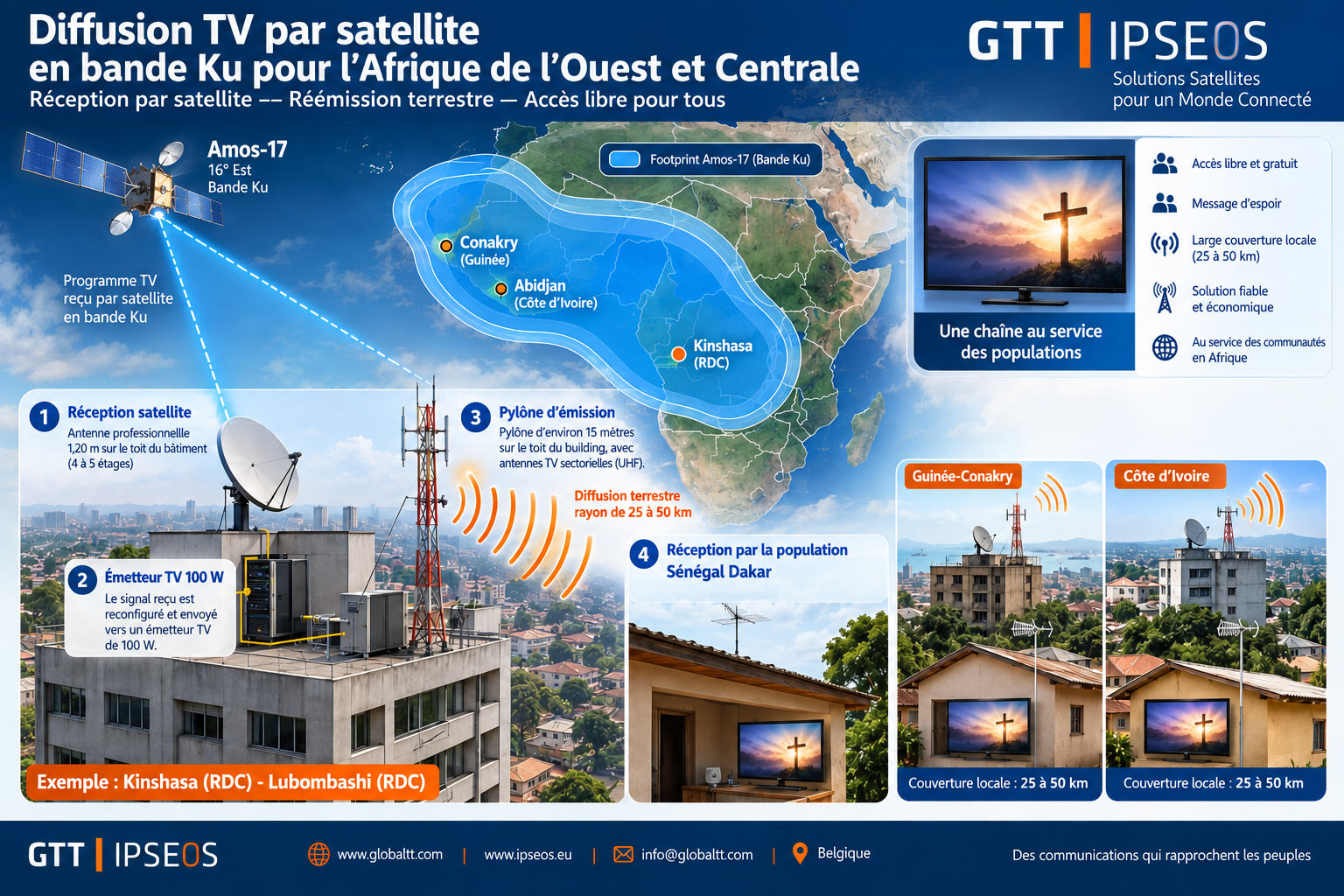
The operating principle is straightforward: your programme is received locally from the satellite and injected into a terrestrial transmitter to serve the target area. Depending on transmitter power, antenna height, terrain, local radio-frequency environment and regulatory approvals, a local coverage radius of approximately 25 to 50 km may be achievable per site.
Satellite reception
A 1.20 m professional antenna on the roof of a four- to five-storey building.
100 W TV transmitter
The received signal is reconfigured and sent to a 100 W television transmitter.
Transmission mast
A mast of approximately 15 metres on the roof of the building, with sectoral UHF television antennas.
Reception by the population
Terrestrial coverage across a radius of 25 to 50 km.
Technical specifications
Reception antenna
1.20 m professional, rooftop
Transmitter power
100 W
Mast height
Approximately 15 m
Transmit antennas
Sectoral UHF television antennas
Local coverage
25 to 50 km radius per site
Standards
Analogue where authorised, DTT / DVB-T / DVB-T2
Technical values shown here are taken from the GTT | IPSEOS coverage documentation dated July 2026.
A worked example
This diagram documents a specific customer deployment for a religious broadcaster, shown as supplied. It illustrates the architecture, not a generic service offer.
We can provide or integrate:
- Analogue transmitters, where this mode remains legally authorised and commercially relevant
- Digital terrestrial television transmitters — DTT / DVB-T / DVB-T2, depending on the national standard
- Satellite reception antennas and professional decoding equipment
- Encoders, multiplexers, modulators and monitoring systems
- Suitable electrical infrastructure, including backup-power solutions where required
- Multi-site architectures using several moderate-power transmitters
In many cases, a network of several carefully located moderate-power transmitters is more resilient and more economical to operate than a small number of very high-power transmitters. This model can reduce cooling and energy requirements, simplify maintenance and improve service continuity.
Terrestrial retransmission is quoted per project. Budget on request.
Request a proposal
To prepare an accurate proposal, we assess your playout server, video format, stream bitrate, transport protocol — such as SRT, Zixi or another solution — as well as your existing IP encoders, VSAT systems, modems and satellite transmission equipment.